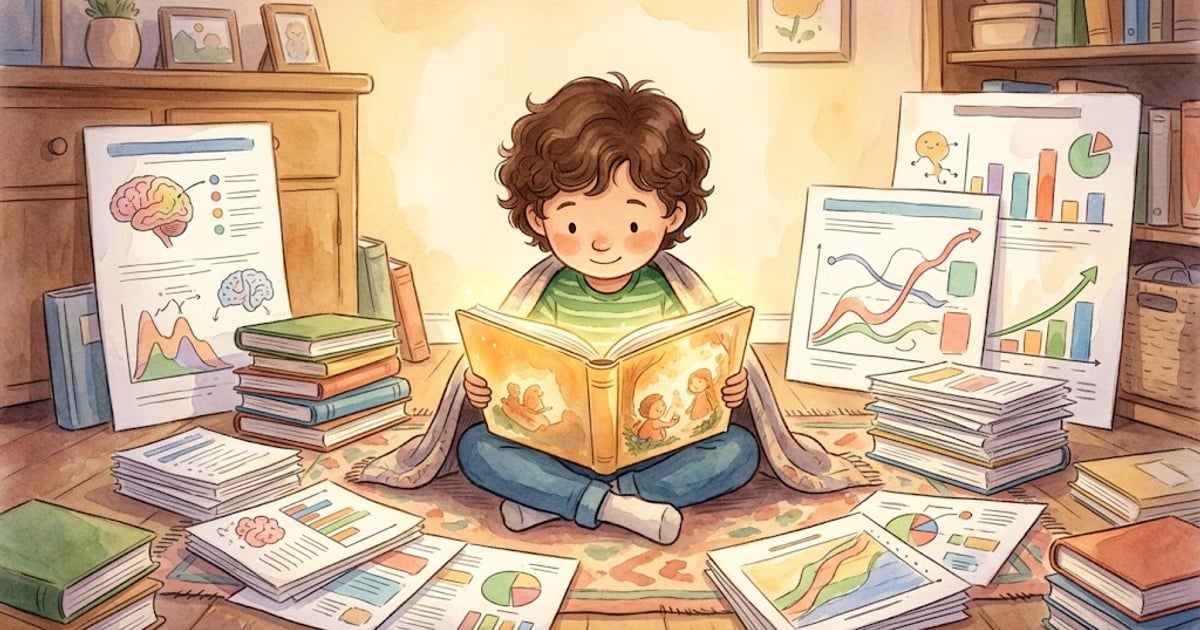
Short answer: yes, with caveats. Peer-reviewed research consistently shows that personalized books improve reading engagement, comprehension, and self-identity development in young children. AI-generated storybooks inherit those same benefits when they maintain content quality and age-appropriate material. The concerns are real but manageable, and the upside for reluctant readers is significant.
Below is what the research actually says, what parents should watch for, and where the field is headed.
Key Takeaways
- Children read personalized books 3 to 5 times more often than generic ones, according to multiple studies on reading behavior
- Personalized reading materials are linked to a 30% improvement in reading comprehension scores
- Only 32.7% of children ages 8 to 18 say they enjoy reading, per the National Literacy Trust's 2025 annual survey
- School districts piloting AI-assisted reading programs report a 19% improvement in student engagement
- 35% of parents now prefer custom-created books featuring their child over off-the-shelf alternatives
What Does Research Say About Personalized Books and Child Development?
The idea that children engage more deeply with stories about themselves is not new. Developmental psychologists have studied it for decades. What's changed is the scale at which personalization is now possible and the growing body of data confirming its effects.
Reading Frequency and Engagement
Children who see themselves in a story pick that book up again. Studies on personalized children's literature consistently find that kids read customized books 3 to 5 times more frequently than non-personalized alternatives. That repetition matters. Repeated reading is one of the strongest predictors of vocabulary acquisition and reading fluency in early childhood, a finding reinforced by decades of literacy research.
The engagement gap is especially striking for reluctant readers. Children who resist traditional books often respond differently when the protagonist shares their name, appearance, and interests. The story stops being something abstract and becomes something personal. For a child who associates reading with boredom or frustration, that shift can be transformative.
Comprehension and Retention
Personalization does more than get kids to open a book. It helps them understand what they read. Research on adaptive learning materials shows a 30% improvement in reading comprehension when content is tailored to the individual child. The mechanism is straightforward: when a child identifies with the main character, they process the narrative more deeply. They make predictions, draw inferences, and connect story events to their own experiences.
This aligns with what cognitive scientists call the self-reference effect. Information processed in relation to the self is remembered better than information processed in other contexts. A child reading about a character who looks like them, lives in a place like theirs, and faces challenges they recognize will retain more of the story's content, vocabulary, and moral lessons than a child reading about a generic character in an unfamiliar setting.
Self-Identity and Representation
Representation in children's literature has been a persistent problem. Despite improvements, many children still rarely see characters who look like them in mainstream books. AI-generated storybooks can address this gap directly. A parent can create a book where the hero has their child's skin color, hair texture, body type, and cultural background. No waiting for a publisher to decide that demographic is commercially viable.
This matters for identity development. Children's literature researchers have long documented how seeing oneself reflected in stories builds self-esteem and a sense of belonging. For children from underrepresented backgrounds, a personalized book might be the first time they see a protagonist who genuinely looks like them. That's not a small thing.
The Literacy Crisis: Why New Approaches Matter
The case for AI-personalized books becomes more urgent when you look at where childhood literacy stands right now.
The National Literacy Trust's 2025 annual survey found that only 32.7% of children ages 8 to 18 say they enjoy reading. That number has been declining for years. Reading for pleasure is at its lowest recorded level since the organization began tracking it. The causes are complex, spanning screen competition, changing attention patterns, and shifting cultural attitudes toward books, but the trend is clear: traditional approaches to getting kids to read are losing ground.
Meanwhile, reading proficiency scores tell a similar story. National assessments consistently show that a significant portion of students read below grade level. The pandemic accelerated existing declines, and recovery has been uneven. Schools are looking for interventions that work, and many are turning to technology.
Several school districts have begun piloting AI-assisted reading programs, and early results are encouraging. Districts using adaptive, personalized reading technology report a 19% improvement in student engagement compared to standard curricula. These programs use AI to match reading material to individual student interests and reading levels, a principle that maps directly to what personalized storybooks do at home.
When 35% of parents already prefer custom-created books featuring their child over off-the-shelf options, and the data supports that preference, dismissing AI storybooks as a gimmick misses what's happening on the ground.
Benefits of AI-Generated Personalized Storybooks
The research points to several specific advantages that AI storybooks offer over traditional children's books.
Reading Motivation for Reluctant Readers
The biggest win is getting non-readers to read. When a child who normally avoids books suddenly wants to hear "their story" at bedtime every night, the downstream effects compound. More reading leads to better vocabulary. Better vocabulary leads to better comprehension. Better comprehension leads to better academic performance across subjects, not just language arts.
AI storybooks let parents create new stories on demand, which solves another problem: children who love a personalized book can get new ones regularly instead of rereading the same gift book until it falls apart. Fresh content with consistent personalization maintains engagement over time.
Vocabulary and Language Development
Personalized stories can be tuned to a child's current reading level and gently stretch it. A parent creating an AI storybook can select themes and settings that introduce new vocabulary in context. A story about a child exploring a coral reef teaches words like "anemone" and "current" naturally, through narrative rather than flashcards.
The language acquisition research is clear: children learn new words best when they encounter them in meaningful, engaging contexts. A personalized story where the child is the one discovering these words creates exactly that context.
Emotional Development and Empathy
Stories have always been tools for emotional learning. Children process difficult experiences, like starting a new school, dealing with a sibling, or overcoming a fear, through narrative. When the character going through that experience is them, the processing is more direct.
Parents can create stories that address specific challenges their child is facing. A child anxious about a hospital visit can read a story where a character who looks just like them goes to the hospital and comes out fine. A child dealing with a move to a new city can read about their own adventure of exploring a new neighborhood. This kind of targeted bibliotherapy has documented benefits in child psychology, and AI makes it accessible to any parent, not just those who can find the right book on a shelf.
Parent-Child Bonding
Creating a story together adds a layer that pre-made books can't match. When a parent and child sit down to choose a theme, pick a setting, and then read the resulting story, it becomes a shared creative experience. The book itself becomes a conversation starter: "What should happen next time?" "Where should you go in the next story?" That collaborative element strengthens the parent-child reading ritual.
Addressing the Concerns
The benefits are real, but so are the concerns. Parents and educators raise valid questions about AI-generated content for children, and those questions deserve honest answers.
Screen Time and Digital vs. Print
The most common objection is that AI storybooks are just more screen time. This concern is reasonable but somewhat misplaced. The pediatric research on screen time distinguishes between passive consumption (watching videos) and active engagement (reading, creating, problem-solving). Reading a digital storybook falls into the active category. The American Academy of Pediatrics' media guidelines emphasize content quality over screen minutes for children over two.
That said, many AI storybook platforms offer PDF downloads that parents can print. The story doesn't have to live on a screen. And for families that prefer physical books, the option to print means the AI component is only part of the creation process, not the reading experience itself.
Content Quality and Accuracy
AI-generated text can produce awkward phrasing, logical inconsistencies, or age-inappropriate content. This is a legitimate concern. The quality of AI writing has improved dramatically, but it's not perfect. Parents should read through any AI-generated story before sharing it with a child, just as they'd preview any new book.
The better AI storybook platforms build content moderation into the generation pipeline. Stories pass through safety filters that check for inappropriate language, violent scenarios, and content that doesn't match the selected age range. This doesn't make human review unnecessary, but it provides a baseline of quality control.
Data Privacy and Photo Safety
When a platform asks for a child's photo to create a personalized character, parents should know exactly what happens to that image. This is the most serious concern, and it has a straightforward test: read the privacy policy and check whether the platform uses children's photos for AI model training.
Privacy-first platforms handle this by converting photos to text descriptions of the child's appearance. The text description drives the illustration engine, and the original photo never touches the AI image model. This approach means no biometric data is extracted, no facial templates are created, and the photo can be deleted at any time without affecting previously generated stories.
At StoryPic, we built this architecture from the start. Your child's photos are stored encrypted and are never used for model training. You can delete all data at any time. Our full practices are documented on our child safety page, and we answer common privacy questions in our FAQ.
Over-Reliance on Technology
Some parents worry that using AI to create stories might replace human creativity or diminish the value of traditionally authored books. This is worth acknowledging. AI storybooks work best as a complement to a child's reading diet, not a replacement for it. A library card, regular trips to a bookstore, and exposure to diverse authors and illustrators remain important.
The research doesn't suggest that personalized books should be the only books a child reads. It suggests they're an effective tool for building the habit and motivation to read, especially for children who haven't found that motivation elsewhere.
What Does the Future Look Like?
The convergence of AI capability, parental demand, and literacy challenges is pushing this field forward quickly. School districts that once viewed AI reading tools with skepticism are now running pilot programs. Publishers that initially dismissed AI-generated books are exploring hybrid models. Parents who were hesitant two years ago are now creating stories weekly.
The key developments to watch include adaptive difficulty, where AI adjusts vocabulary and sentence complexity to match a child's reading level in real time, multilingual story generation for bilingual families, and integration with classroom reading programs. The technology is moving fast, but the fundamentals remain the same: children who see themselves in stories read more, and children who read more develop better.
The question isn't whether AI children's books are good for kids. The research answers that clearly. The question is whether individual platforms implement the technology responsibly, with content safety, privacy protection, and age-appropriate quality controls. Parents who ask the right questions and choose the right tools can give their children something genuinely valuable: a book that makes them want to read.
See It in Action
Upload a photo and create a personalized storybook your child will actually want to read. Your first story is free.
Create a Free Story →Frequently Asked Questions
At what age can children benefit from personalized AI storybooks?
Children as young as two can benefit from personalized read-aloud stories, where a parent reads the book to them. The engagement boost from seeing a character that looks like them works across the preschool and early elementary range (ages 2 to 8). For independent reading, personalized books are most impactful for emerging readers ages 5 to 9 who are building fluency and need motivation to practice. Children older than 9 also benefit, particularly reluctant readers who haven't connected with traditional books.
Are AI-generated stories as good as human-written children's books?
The best human-written children's books, the ones by authors who've spent years perfecting their craft, remain a higher standard than current AI output. AI stories are competent and improving, but they don't match the artistry of a Caldecott winner. That said, the comparison misses the point. AI storybooks solve a different problem: they create personalized content on demand, which no human author can do at scale. The ideal reading diet includes both traditional books and personalized ones. They serve different functions.
How can I make sure an AI storybook is safe for my child?
Check three things before using any platform. First, read the privacy policy and confirm the platform does not use children's photos for AI model training. Second, verify that the platform has content moderation filters on generated text and images. Third, look for data deletion options that let you remove all stored information at any time. Platforms that are transparent about their safety practices, like publishing a dedicated child safety page, are generally more trustworthy than those that bury this information in legal documents.
Do schools use AI-personalized reading materials?
Yes, and the trend is growing. Multiple school districts have piloted AI-assisted reading programs that adapt content to individual student interests and reading levels. Early results show a 19% improvement in student engagement compared to standard curricula. These programs are typically used as supplements to existing reading instruction, not replacements. The approach mirrors what parents can do at home with AI storybooks: match the right content to the right child to build motivation and practice volume.
See It in Action
Upload a photo and create a personalized storybook your child will actually want to read. Your first story is free.
Create a Free Story →